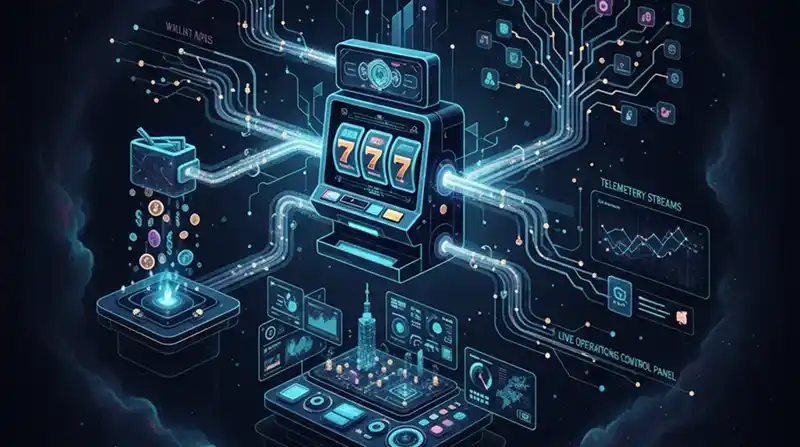
The Client Never Operates in Isolation
Outwardly, a slot game is perceived as a visual product, but its reliability is determined by how well it's embedded within the platform's systemic framework. Even a flawless client loses value if it poorly interacts with the wallet API, struggles to correctly restore state, sends incomplete analytical events, or integrates poorly with the operator's bonus logic. Therefore, backend integrations must be designed as a core part of product design, not merely a supporting layer.
In B2B development, this is particularly evident: the same game might launch in various contexts, with different protocols, response time limits, and promotional campaign logic. If the client architecture isn't prepared for such variations, each new integration risks becoming a mini-project prone to regressions.
Wallet Flow and Transaction Predictability
For the player, the wallet flow should be almost invisible: a bet is placed, the result recorded, the balance updated, and the history consistent. However, behind this simplicity lies a rather stringent contract. It's crucial to consider the order of calls, timeouts, idempotency, behaviour upon redelivery, rollbacks, and connection disruption scenarios. Errors in these areas not only impact the user experience but also erode brand trust.
We recommend structuring the wallet flow as a state machine. This way, each transition receives an explicit description: what constitutes a confirmed state, which responses are permissible, which telemetry event is dispatched, and what actions to take in disputed cases. This approach significantly streamlines QA and accelerates platform integration approvals.
Telemetry as a Solution Tool, Not an Archive
Raw data is meaningless if the team can't transform it into actionable solutions. Therefore, telemetry must address specific product questions: where players drop off, how frequently they reach a bonus, which configurations yield longer sessions, and how behaviour changes after promotional modifiers. We design events not as a "collect everything" approach, but as a map for monitoring key phases of the player experience.
It's also crucial to maintain strict naming and versioning conventions. If different teams interpret the same event differently, analytics ceases to be a reliable source of truth. In a production studio, the telemetry schema should reside alongside API contracts and product assumptions.
Remote Config and Live Ops
Today's stable games rarely remain unchanged post-release. Operators demand flexibility: altering promo availability, enabling seasonal skins, adjusting information panels, and adapting communication for different markets. Hence, we implement remote config not as a dangerous hidden lever, but as a limited and thoroughly documented system of parameters. It must be secure, observable, and not compromise the core mathematics.
A well-designed live ops layer creates genuine value for the publisher. It allows for maintaining product relevance without a new full development cycle, and enables studios to launch content-driven events and CRM integrations more swiftly. However, this only works when technical limitations and the scope of permissible changes are agreed upon upfront.
Integration Maturity as a Competitive Advantage
As more games enter the market, a mere "pretty front-end" becomes less valued. Clients seek partners who can manage the entire chain: client, API, telemetry, compliance, and supportability. Integration maturity is now a key part of the commercial offering, as it directly reduces time-to-market and the cost of errors.
For this reason, we view backend integrations not as technical drudgery, but as the core of brand reliability. A game should not only impress but also thrive in the real operational world, free from log chaos, manual workarounds, and unpredictable incidents.